Historic Sites
Humayun's Tomb
The 1570 tomb-garden of the second Mughal emperor and the direct architectural ancestor of the Taj Mahal, an hour from Gurugram.
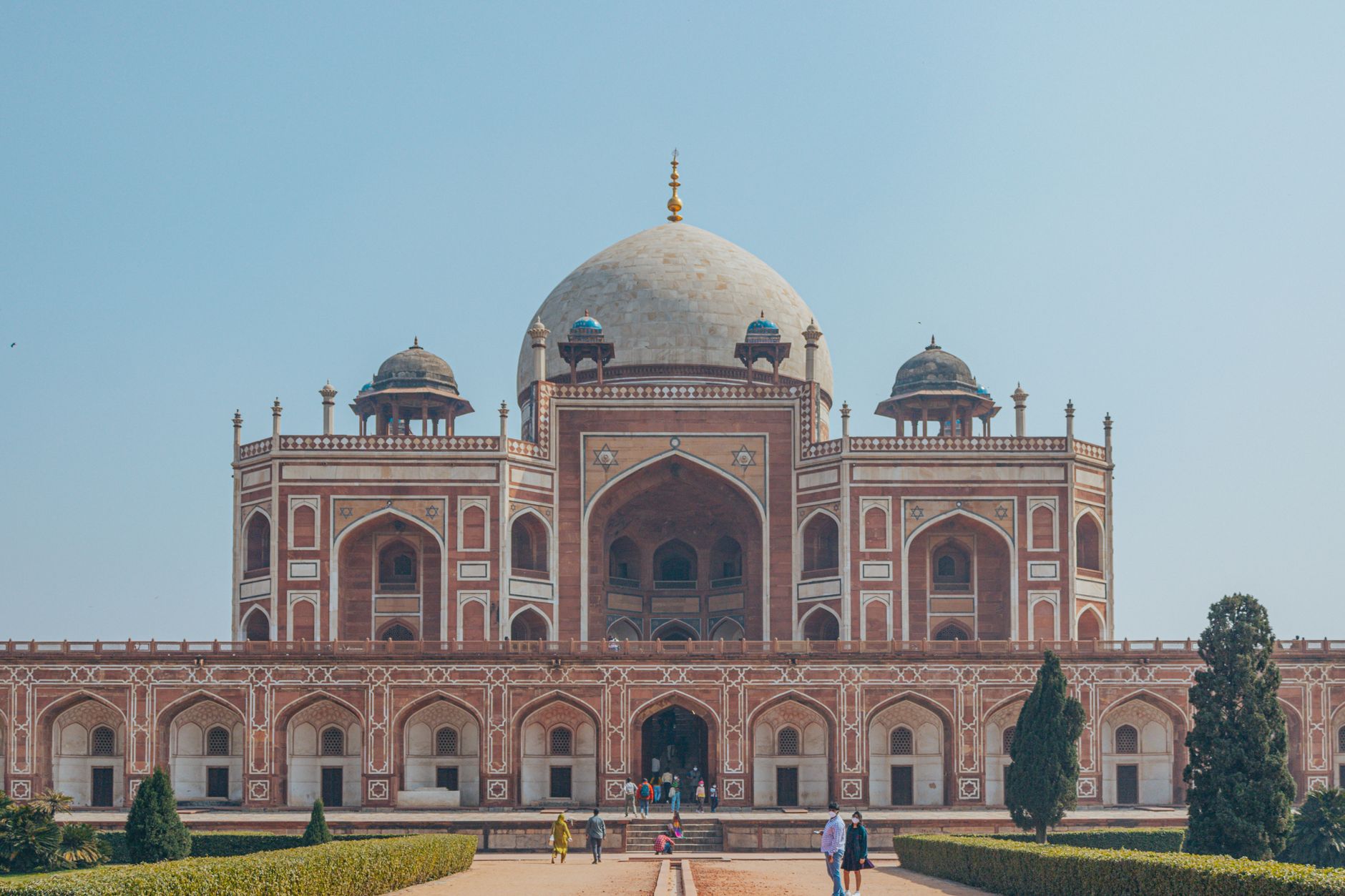
Commissioned by Empress Bega Begum in 1565 and completed in 1572, Humayun's Tomb was the first garden-tomb built in the Indian subcontinent and the direct architectural ancestor of the Taj Mahal seventy years later. Its four-quartered charbagh garden, symmetrical red sandstone mass and central marble dome established every element the Taj later refined. A UNESCO World Heritage site since 1993, it has been beautifully restored by the Aga Khan Trust for Culture over the past two decades. The architect, Mirak Mirza Ghiyas, was brought from Herat, and the logic of the building is Persian: a double dome roughly 42.5 m high over an octagonal core, four near-identical facades of red sandstone banded with white marble, and no single front. Later Mughals kept burying relatives in the vaulted chambers of the plinth — well over a hundred graves, which earned the place its nickname, the dormitory of the Mughals — and it was in these arcades that Bahadur Shah Zafar was taken prisoner in September 1857. Walk the whole plinth terrace before you step inside.
The complex is unusually rich for a single monument. Beyond the main tomb are the tomb of Isa Khan (older than Humayun's, completed 1547) with its own octagonal enclosure, the Arab Serai gateway, Nila Gumbad, the Barber's Tomb inside the main garden, and Bu Halima's garden at the western entrance. The Aga Khan restoration includes an interpretation centre near the main gate, opened in 2022, which is genuinely worth the twenty minutes. Take the loop anticlockwise: Bu Halima's gateway drops you onto a gravel path, turn left for Isa Khan's sunken enclosure and its Lodi-style mosque, continue through the Arab Serai past the Afsarwala tomb and mosque, and only then pass the west gate into the main charbagh. Nila Gumbad, on the eastern edge beside the Hazrat Nizamuddin railway lines, is the piece nearly everyone skips — a ten-minute detour, usually empty, and the best tilework on the site. Ninety minutes covers that circuit at an unhurried walking pace.
From Gurugram this is a 45-60 minute drive depending on traffic — go at weekends when Delhi's roads are lighter, or take the metro. Enter at 6am opening if photography is the goal; the crowd builds after 10am and by afternoon it is full of school groups. Buy tickets on the ASI online portal. Combine with Nizamuddin Dargah, a ten-minute walk, and Sunder Nursery just next door, which shares a common entry with Humayun's Tomb on a combo ticket. At the gate, ignore the men offering to guide you until you have seen a Ministry of Tourism licence card, and fix both the fee and the route before anyone starts walking — an unlicensed hour of half-remembered anecdotes will cost several times your ₹40 ticket. Still photography is free and a phone is plenty; a video camera needs a small extra ticket, while tripods, drones and pre-wedding shoots require written ASI permission that is never issued on the spot.
Driving is the default from Gurugram. Head north on NH-48 from Cyber City, come off at Dhaula Kuan and take the Ring Road to Lodhi Road and Mathura Road: about 28-30 km, 45-60 minutes off-peak, closer to 90 minutes if you leave at 9am on a weekday. App cabs quote roughly ₹500-700 each way, so the return journey costs ten to fifteen times the entry fee. Paid parking sits off Mathura Road at the main entrance and at Sunder Nursery next door; both are full by 10am on Sundays. By metro, ride the Yellow Line from Millennium City Centre Gurugram to Central Secretariat, change to the Violet Line and take two stops via Khan Market to JLN Stadium — ₹50-60 and 70-80 minutes gate to gate, including the 15-minute walk east. Two or more of you: take a cab. Travelling alone: take the metro.
Entry is ₹40 for Indian visitors and ₹600 for foreign nationals, with the combined ticket including Sunder Nursery at ₹90 and ₹700. Buy the combo by default — splitting the two purchases rarely works out cheaper, and the nursery gate is a five-minute walk from the tomb's ticket office. Children under 15 enter free at ASI monuments, so a Gurugram family of two adults and two children pays ₹180 in total; a video camera adds ₹25, and stills cost nothing. There is no restaurant inside the tomb enclosure, so carry water in summer; the food stalls and coffee are all in Sunder Nursery. Realistically your transport dwarfs everything else: about ₹1,200-1,400 for a return cab, or roughly ₹220 for two people on the metro. Book the combo online the night before and skip the window queue entirely.
Gates open at 6:00 and there is no weekly closing day. The first two hours are the reason to set an alarm: low raking light on the west facade, birds in the charbagh channels, and perhaps thirty other people in 30 acres. From 10:00, especially November to February, school buses arrive and the plinth gets loud; weekend afternoons are the worst of it. October to March is the season, though December and January mornings can be fogged in until about 8:30 and November smog flattens the long garden views. April to June puts 42-45°C onto an unshaded sandstone plinth — be out by 9:00. July to September brings the greenest lawns and the fewest visitors between short, heavy showers. Entry is free on 18 April for World Heritage Day, which also makes it the busiest day of the year. Aim for a Tuesday to Thursday, 6:00-8:30.
It suits walkers and photographers above all: flat gravel paths, wide lawns, and four or five separate monuments to circle. Families do well — children under 15 are free and there is space to run, though no playground, no shade for a picnic in June and nothing interactive beyond the interpretation centre. Strollers roll fine along the garden paths but cannot reach the plinth, which is a steep flight of stone steps with no lift; wheelchair users can loop the charbagh, see Isa Khan's enclosure and photograph the facade, but the burial chamber is out of reach. Teenagers with no interest in architecture will be done in 45 minutes. On a wet afternoon there is almost nowhere covered to shelter. With a one-hour gap before a train from Hazrat Nizamuddin station, 1.5 km away, it works: west gate, plinth, chamber, out in 35 minutes.
Sunder Nursery, on the same combo ticket, is the obvious pairing — a 90-acre heritage park five minutes north with Sunder Burj, Lakkarwala Burj, a lotus pond, a bonsai house and the site's only real food stalls; give it an hour. Nizamuddin Dargah is a 10-12 minute walk west through the lanes of Nizamuddin Basti: free, shoes off and heads covered, with qawwali on Thursday evenings after sunset, and women not permitted into the inner chamber of the saint's tomb. Two minutes further sit Chausath Khamba, the white marble hall of 64 pillars from the 1620s, and Mirza Ghalib's grave. The kebab and biryani shops of Nizamuddin West feed you afterwards. Purana Qila is 2.5 km away, Khan Market one metro stop for lunch, Lodhi Gardens and the Lodhi Art District about 4 km west.
The honest caveat is the interior. Sold as a dress rehearsal for the Taj Mahal, the burial chamber is one dim octagonal room holding a plain marble cenotaph — the actual grave lies in a sealed chamber below and you cannot see it. There is no pietra dura inlay, no jewelled marble, no glow: the pleasure here is mass, symmetry and garden, all of it outside. Nila Gumbad and the Arab Serai are quietly better than their signage suggests, while the Barber's Tomb is a five-minute look, not a destination. The ticket window queue reaches 15-20 minutes on Sunday mornings, worse than most guidebooks admit, and the 15-minute walk from JLN Stadium metro runs beside heavy traffic on thin footpaths. Sunder Nursery, despite the name, is a park — you cannot buy plants there.
Hours & entry
Not free
Mon-Sun 6:00-18:00
What to see
{'what': 'The main tomb of Humayun with its symmetrical charbagh', 'where': 'Central platform, accessed from the west gate'}
{'what': "Isa Khan's tomb and octagonal enclosure", 'where': 'South-west corner, before the main entrance'}
{'what': 'Interpretation centre with 3D restoration models', 'where': 'Just inside the main gate'}
Tips from the ground
Buy the combo ticket that includes Sunder Nursery — big saving.
Best light is 6:30-8:30am; avoid 12-3pm heat.
Combine with Nizamuddin Dargah after dark for the qawwali evenings on Thursdays.
Good to know
Questions, answered
What is the ticket price?
₹40 for Indian visitors, ₹600 for foreign nationals; combo with Sunder Nursery ₹90/₹700. Children under 15 enter free at ASI monuments, so two adults and two children pay ₹180 on the combined ticket. Still photography costs nothing, a video camera adds ₹25, and the counter takes cash and UPI. The only other on-site costs are parking off Mathura Road and a licensed guide, whose fee will comfortably exceed your entry ticket — agree it before you walk through the gate.
Any free days?
Free on World Heritage Day (18 April) each year. That is also the worst day to visit: tour groups and school parties fill the charbagh by mid-morning and the crowd runs at roughly double a normal Saturday. There is no free evening window, no free final hour and no resident discount. Children under 15 go free every day of the year, which covers most families anyway. On any other date, budget ₹40, or ₹90 for the Sunder Nursery combo, and treat it as settled.
How long do I need?
Two hours for the tomb complex; add another hour for Sunder Nursery. Split it as roughly 20 minutes for Isa Khan's enclosure and the Arab Serai, 40 minutes on the plinth and inside the chamber, 20 minutes in the interpretation centre, 10 minutes out to Nila Gumbad and the rest walking the garden channels. A 40-minute dash is possible if you have a train from Hazrat Nizamuddin, 1.5 km away: west gate, plinth, chamber, out, skipping the outer tombs entirely.
When is it closed?
Open every day; last entry 5:30pm. There is no weekly closing day and no seasonal shutdown. Gates open at 6:00 and guards begin clearing the garden around 18:00, so the final hour feels rushed rather than golden. In December and January the fog often does not lift until about 8:30, which shortens the useful morning. There is no night entry and no sound-and-light show, and Sunder Nursery also shuts in the early evening — do it before, not after, the tomb.
Do I need to book?
Online booking on asi.payumoney.com is faster than the counter, but not required. There are no timed slots, so buying on the morning of your visit is fine; the point is avoiding a window queue that runs 15-20 minutes on Sundays and public holidays. Screenshot the QR code, because mobile data around Nizamuddin is patchy. Foreign nationals should carry a passport or copy, as the ₹600 tier is checked at the turnstile. Ask for the Sunder Nursery combo when you buy, not once you are inside.
Nearest metro?
JLN Stadium on the Violet Line, then a 15-minute walk east. From Gurugram, take the Yellow Line from Millennium City Centre to Central Secretariat, change to the Violet Line and ride two stops via Khan Market: 70-80 minutes door to gate for ₹50-60 each way. Jangpura, the next Violet Line station, is a similar distance. The walk follows busy roads with thin footpaths, so an auto or e-rickshaw at ₹40-60 is a fair trade. Last trains leave central Delhi around 23:00.
Doing good is the business: every booking through Stay Gurugram funds one verified tonne of carbon removal — same room, same price, no markup.
Start your search